
Therapy-Speak Fatigue
What We Lose When We Pathologize Every Flaw

Note to reader: If this feels familiar, you’re not imagining it. I’ve touched on this topic recently, but it’s been rattling around in my head with such insistence that I couldn’t help returning to it but from a slightly different vantage point.
There was a time, circa AIM away messages and MySpace Top 8s, when red flags were endearingly low-stakes. A suspicious love of Nickelback. An unusual number of reptiles. The phrase “alpha male” said without irony. These days, the same traits have been rebranded with clinical gravitas. You’re not dating someone who’s emotionally aloof; you’re entangled with an avoidantly attached individual. You're not arguing; you're re-enacting a formative wound. And you're not drifting from someone, you’ve come to realize they are categorically toxic.
Therapy-speak has migrated from the sanctum of clinicians' offices into the algorithmic bloodstream of the internet, where it circulates through TikTok confessionals and carousel posts on Instagram. What was once private and process-oriented has become a public dialect, mass-replicated and easily consumed. It’s now the native idiom of a certain kind of internet persona: part wellness influencer, part autodidactic psychologist, part self-help evangelist. The kind who totes around a heavily annotated copy of The Body Keeps the Score and references Attached like scripture. I say this without scorn. I’ve read them too.
But what began as a lexicon of introspection has calcified into a performance of emotional sophistication—a way to signal that you’re enlightened, evolved, and deeply in touch with your inner child, even as you misdiagnose everyone around you.
In case you are new around here, I am far from anti-therapy. I am studying to be a therapist. I have logged more hours in therapy than I have at brunch, and I live in Brooklyn, so that’s not insignificant. Therapy has rewired my cognition in ways that feel sacred. But the trouble arises when therapeutic language is stripped of its clinical context and repurposed for digital consumption. Complex psychological concepts are reduced to 15-second reels and pastel infographics urging you to sever ties with anyone who doesn’t immediately validate your boundaries.
We no longer say, “My friend has been distant.” We say, “I’ve decided to disengage from a dynamic that lacks mutual emotional investment.” We don’t admit, “I hurt someone.” We say, “I acted from an unhealed place.” It sounds enlightened, until you realize you’ve ghosted someone you love because they were preoccupied with their newborn and didn’t text you back.
This isn’t just linguistic inflation. It’s conceptual erosion. A slow decay of nuance where the messy sprawl of human behavior gets collapsed into diagnostic shorthand. We’ve started scanning for pathology like we’re running antivirus software on our dating lives. Is he emotionally unavailable or just introverted? Is your boss a narcissist or simply from the Midwest, where emotional repression is a regional dialect? Are you in love, or have you been love-bombed by someone who quotes Ram Dass before bed and can recite your rising sign faster than your name?
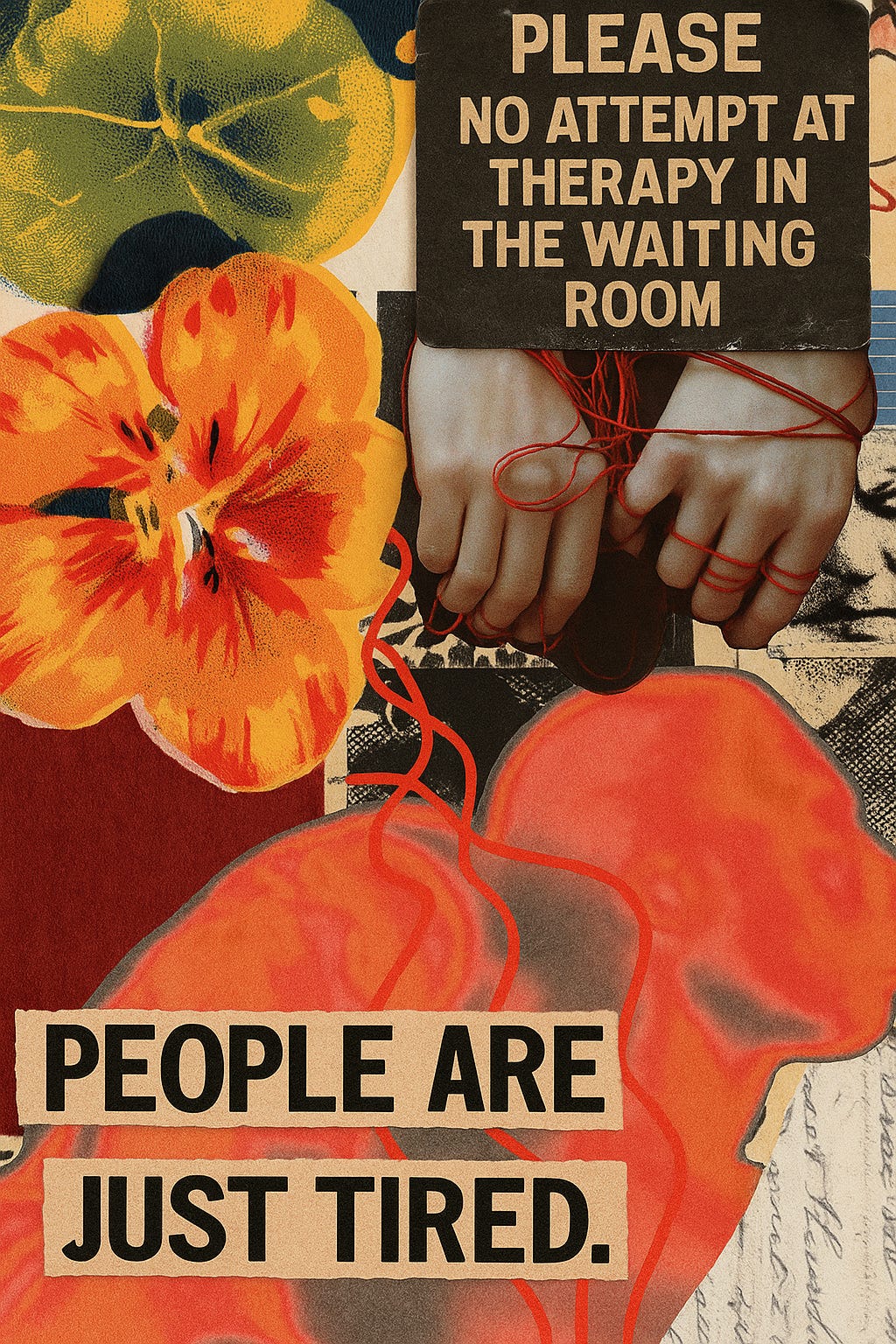
We are being trained to read one another not as people but as case studies. In our hunger to appear emotionally literate, we’ve lost our appetite for complexity. People are not flags. They’re not Google Forms to be evaluated and dismissed if they fail to check the right boxes. They are contradictory, complicated, and often just profoundly tired. And yes, they will disappoint you—not always because of some deeply embedded trauma, but occasionally because they forgot.
The friend who didn’t call you back may not be emotionally unsafe. She might be working two jobs, caring for a parent with dementia, and simply trying to hold it together. The partner who missed your anniversary may not be gaslighting you. He might be forgetful, overwhelmed, and still utterly in love with you.
The proliferation of therapy-speak has created a moral binary that doesn’t map onto lived experience. A missed call becomes abandonment. A disagreement becomes psychological warfare. Someone asking for space is no longer self-regulating, they're stonewalling. The entire emotional spectrum has been recast in diagnostic terms, leaving little room for ambivalence, contradiction, or simple human error.
We have all become amateur diagnosticians, armed with just enough psychological terminology to pathologize one another but not nearly enough to hold space for complexity. We use this language to avoid discomfort, sidestep vulnerability, and rationalize our exits. It's easier to cite someone's "inability to co-regulate" than to admit that relationships are just... hard. That repair is awkward. That staying requires stamina.
Of course, language is essential. Naming an experience can be revelatory. Terms like gaslighting and codependency offer lifelines to people in real pain. But these words are meant to clarify, not to condemn. They are tools, not cudgels. They are supposed to make us braver, not more avoidant.
And therapy, real therapy, isn’t performative. It’s not an aesthetic. It’s not some windswept tableau captioned “healing” like the tide itself is doing emotional labor. It’s deeply unsexy work. It’s crying in your car. It’s crying in your shower. It’s sitting in the sludge of your own defensiveness. It’s learning that boundaries are not iron gates. They are invitations to re-engage with clarity, not excuses to disengage entirely.
Not every flaw is a trauma reenactment. Some people are just flawed. Still good. Still learning. Still worthy of love. The boyfriend who goes silent when stressed may not be emotionally unavailable. He may have grown up in a home where silence was survival. The friend who gets defensive may not be unsafe. She may have never learned how to be wrong and still be loved.
I miss forgiveness. I miss being able to say, “He’s terrible at texting, but he brings me matcha when I cry.” I miss the freedom of trusting my own instincts without needing to consult seven sliding-scale therapists on Instagram. I miss believing that people can be more than the worst thing they said during an argument.
It is okay to love people who are still becoming. It is okay to stay when things are imperfect. To say, “This hurt,” and choose not to leave. To believe that repair matters, even when it’s slow and halting. Not everything is a red flag. Some people are just late. Or cranky. Or premenstrual. Or trying their best with what little they have left.
So maybe the most subversive thing we can do right now—the truly countercultural move—is not to discard every relationship that bruises us. Maybe it is to hold both harm and humanity in the same breath. To say, “This hurt me, and I still care.” To believe that love can stretch, accommodate, and endure.
Because real love, the kind that survives morning breath and parallel scrolling on the sofa, is not forged in the pristine spaces of emotional exactitude. It is built in the mess. In the repair. In the act of choosing again. And sometimes, the most sacred thing we can say is not “This is a trauma response.” It is “I know. I still want to try.”
x,
Stephanie
If my writing made you nod along, feel a little less alone, or just gave you something to overthink later, consider buying me a coffee. It’s a small way to say, “Hey, keep doing the thing,” and I’d really appreciate it.
“I acted from an unhealed place.”
I've heard this from a man who was trying to excuse the damage he had done. Unbeknownst to me at the time, he was still doing damage. I missed the red flag because I was chest-deep in spirituality, while also drinking myself stupid most nights. Now that I know, anytime I see or hear that phrase or anything similar to that, I literally feel sick to my stomach.
"It's not that deep" is a thought that I have on an almost regular basis when scrolling social media. A lighthearted comment in the thread will be thwarted by a gang of "armchair psychologists"; of whom jump at every chance to over-analyze a TikTok video that is meant to be a satire.
A poignant reminder that some things come to worldwide mainstream attention and get hijacked and misused. I appreciate this take, Stephanie. I hadn’t really thought about therapy-speak being weaponized, since in my own experience with therapy and self-study, I have found answers and clarity to many—if not all—of the painful things I have lived through. Yet, as I recall many interactions, particularly on social media, it’s definitely apparent that it has been overused and commodified to fit narratives or serve ulterior motives, instead of what it should have always been: the strengthening of our internal compass—a recalibration toward self-accountability, and inner knowing.